DTF, screen print, embroidery — what's actually different
Three methods. Every apparel brand uses at least one of them. Most brands don't explain what they chose or why. Here's what each process actually does to the garment — and why it matters for what you end up wearing.
When you see artwork on a garment, it got there one of a few ways. The method isn't just a production detail — it affects how the artwork looks on day one, how it holds up after a hundred washes, and what kinds of designs are even possible. These are the three main methods used in premium apparel.
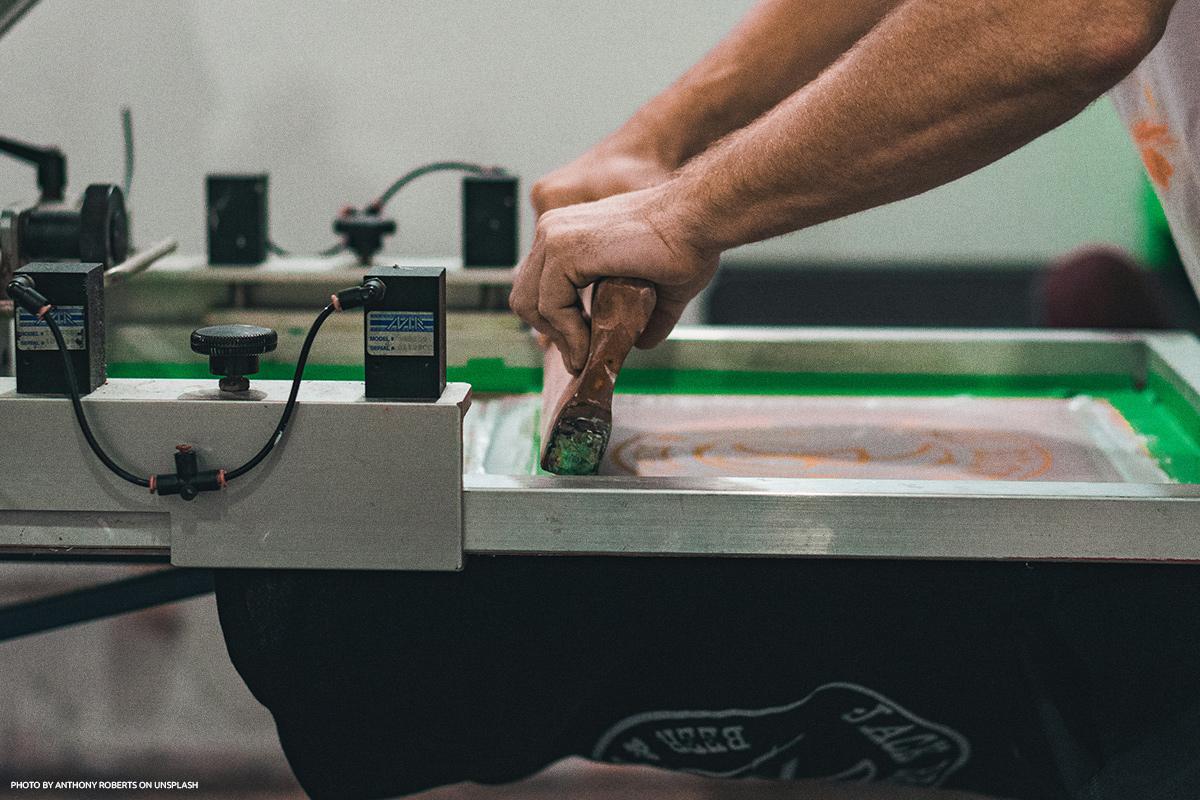
Screen printing
Screen printing is the oldest and most widely used method. Ink is pushed through a mesh screen onto the fabric — one color at a time, one screen per color. The result is opaque, flat, and extremely durable. A well-executed screen print can outlast the garment itself.
The limitation is complexity. Each color requires a separate screen. Gradients are difficult. Photorealistic artwork with dozens of color transitions is either impossible or prohibitively expensive. It's also a batch process — you need minimum quantities to justify the setup cost, which is why screen printing is the default for mass production and why small-run, highly detailed artwork is rarely done this way.
Screen printing is ideal for bold, flat designs with few colors. It's the method behind most band tees, brand logos, and political shirts — designs built for the process, not against it.
Embroidery
Embroidery is thread, not ink. A machine drives a needle through the fabric, building the design stitch by stitch. The result is three-dimensional, tactile, and permanent in a way no print can match. Embroidery doesn't fade. It doesn't crack. It becomes part of the fabric.
The constraints are significant. Embroidery works for logos, text, and simple graphic elements — anything that can be rendered in solid thread without fine detail. Photorealism is impossible. Gradients are impossible. Very small text gets lost in the stitch density. The cost scales with stitch count, not color count, which makes large embroidered areas expensive.
This is why premium brands use embroidery for their logo mark — chest logo, sleeve hit, back-of-neck label — and use other methods for complex artwork. The embroidery signals quality through texture. You feel it before you read it.
DTF — Direct to Film
DTF is the newest of the three methods, and it solves the problems the other two can't. Artwork is printed onto a film, coated with adhesive powder, and heat-transferred onto the garment. The result can handle unlimited colors, photorealistic detail, gradients, fine lines — anything a digital file can contain.
The durability question is the one most people ask about DTF, because it's newer and the answer used to be complicated. Modern DTF transfers, applied correctly to the right fabric weight, are wash-stable and long-lasting. The key variables are the quality of the transfer film, the adhesive formulation, and the base fabric — a heavy, tight-weave cotton holds a DTF print significantly better than a lightweight poly blend.
DTF is why complex, original artwork on a garment is now possible at small quantities. The design doesn't have to be simplified to fit the process. The process adapts to the design.
Why PHAZD uses DTF for artwork and embroidery for branding
The artwork on each PHAZD drop is original and complex — the kind of design that would be impossible or prohibitively expensive via screen print, and completely impossible via embroidery. DTF is the only method that lets the artwork be what it needs to be without compromise.
The PHAZD logo mark on every piece is embroidered. Embroidery signals permanence in a way that print can't — you feel the difference when you run your hand across it. The brand mark survives everything the garment survives, without exception.
Two methods, two different jobs. When you run your thumb across the chest of a PHAZD piece, you can feel where one ends and the other begins.